


Rational optimization of NiS–CoS composite nanoparticles via controlled co-precipitation for high-efficiency supercapacitors

Abstract
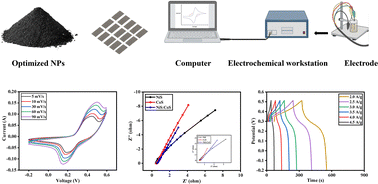
The optimization of composite metal sulfides represents an effective strategy for enhancing supercapacitor performance. In this study, nickel–cobalt sulfide (Ni–Co sulfide) nanoparticles were synthesized through a simple co-precipitation method by systematically varying the concentrations of the metal precursors, resulting in the formation of small and stable nanoparticles. Variations in synthesis parameters significantly influenced the particle size, structural characteristics, and optical properties. Comprehensive characterization was carried out to assess particle size distribution, stability, and optical behavior. Parameter optimization led to marked improvements in both the stability and electrochemical performance of the Ni–Co sulfide nanoparticles. The optimized material exhibited excellent supercapacitor performance, delivering a specific capacitance of 797 F g−1 at a scan rate of 5 mV s−1. Furthermore, a high specific power of 520 W kg−1 and a specific capacitance of 1335 F g−1 were achieved at 2 A g−1, along with 99.52% capacitance retention, indicating strong cycling stability. Electrochemical impedance spectroscopy (EIS) revealed a very low charge transfer resistance (0.024 Ω), indicating faster interfacial charge transfer. In addition, computational studies were performed to better understand the underlying charge transfer mechanism. The enhanced performance is attributed to improved electrical conductivity and the increased availability of electrochemically active surface sites. Overall, this study establishes a systematic parameter-optimization approach for tuning composite metal sulfide nanostructures to maximize electrochemical efficiency. The findings highlight the strong potential of Ni–Co sulfide nanoparticles as high-performance electrode materials for practical and sustainable energy storage applications.
 Please wait while we load your content...


