


Effect of hydrothermal reaction time on defect- and strain-engineered few-layered MoS2 nanoflowers for tunable band gap and enhanced visible-light photocatalysis

Abstract
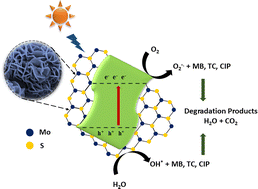
The presence of micro-pollutants in aquatic environments poses a significant challenge due to their trace-level concentrations and persistence, which greatly affect public health and ecological safety. Visible-light photocatalysis offers a sustainable solution to this problem. Molybdenum disulfide (MoS2) is gaining interest as an effective photocatalyst due to its tunable band gap and optical properties. Here, we synthesised two MoS2 nanoflowers (NFs) via a simple hydrothermal route at different reaction times: MoS2-1 (shorter reaction time) and MoS2-2 (longer reaction time). XRD, XPS, FE-SEM, and TEM analysis were used to characterize the crystal structure and morphology of the NFs in detail. XRD data confirm the formation of 2H-MoS2, and MoS2-2 shows an increased d-spacing of the characteristic (002) plane and experiences tensile strain, which is supported by the downshift of the binding energy value of the Mo 3d spectra. The FE-SEM and TEM images reveal that a long reaction time yields defective few-layered MoS2 NFs with an average thickness of about 29.64 nm. Additionally, MoS2-2 shows an increased band gap of 1.63 eV compared to MoS2-1, which shows 1.56 eV, further confirming the formation of thin, strained, and few-layered MoS2 NFs at longer reaction times. These synergistic effects: few-layer, strain, and defects, make MoS2-2 an excellent visible-light photocatalyst for degrading methylene blue (MB), tetracycline (TC), and ciprofloxacin (CIP). The increased PL intensity further supports the formation of cracks/defects, which trap excited electrons and reduce the recombination, leaving holes as the major active species for the degradation. The increased carrier density (Nd) of MoS2-2 (3.82 × 1016 cm−3) reveals the generation of more charge carriers for photocatalysis. The scavenger studies also confirmed the involvement of holes (h+) and hydroxyl (OH˙) radicals as the major reactive species, and a possible degradation mechanism was proposed. Density functional theory (DFT) supports these findings, while LC-MS/MS revealed potential intermediates and pathways. This work offers valuable insights for the development of efficient MoS2 nanostructures for environmental remediation.
 Please wait while we load your content...


