


Effect of hatch spacing on laser-induced graphene: structural tuning and supercapacitor performance
 †bc
Ganjaboy S.
Boltaev,
c
Mahmoud M.
Kaid,
d
Hani M.
El-Kaderi,
d
Ali S.
Alnaser
*ace
†bc
Ganjaboy S.
Boltaev,
c
Mahmoud M.
Kaid,
d
Hani M.
El-Kaderi,
d
Ali S.
Alnaser
*ace
Abstract
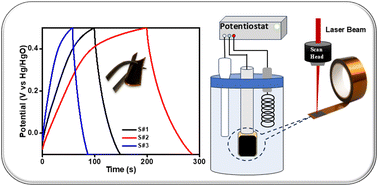
The optimization of the properties of laser-induced graphene (LIG) is crucial for advancing flexible supercapacitor electrodes. This study examines how varying interline (hatch) spacing, 200 µm, 300 µm, and 400 µm, during femtosecond (fs) laser writing on polyimide tape, affects the resulting LIG structure and electrochemical performance. Comprehensive characterization using scanning electron microscopy (SEM), Raman spectroscopy, X-ray diffraction (XRD), and X-ray photoelectron spectroscopy (XPS) revealed that the LIG prepared with 300 µm line spacing (S#2) exhibited the most favorable combination of physicochemical and electrochemical characteristics. S#2 showed the lowest structural disorder (ID/IG = 0.324 ± 0.014), the highest graphitic ordering (prominent (002) XRD peak), and the lowest electrical resistance (34 Ω cm−1). Interestingly, S#2 also demonstrated the highest water contact angle, indicating greater hydrophobicity, yet delivered the best electrochemical performance, suggesting a more complex relationship between surface wettability and charge storage. In a three-electrode configuration with 1 M KOH, S#2 achieved an areal capacitance of 166.6 mF cm−2 at a scan rate of 5 mV s−1 and a specific capacitance of 73.1 mF cm−2 at a current density of 0.5 mA cm−2, along with superior charge–discharge behavior and a low impedance Rct value (44.36 Ω). It also demonstrated excellent cycling stability, retaining ∼100% of its capacitance over 5000 cycles at the current density of 4 mA cm−2, and maintained stable performance under bending, confirming its potential for flexible and wearable energy devices. Furthermore, a flexible symmetric supercapacitor device fabricated using S#2 delivered a specific capacitance of 45.4 mF cm−2 and an energy density of 4.0 µWh cm−2 at 0.5 mA cm−2. These results identify line spacing as a key laser parameter governing the structural, chemical, and electrochemical characteristics of LIG and suggest that surface hydrophobicity may play a beneficial role beyond conventional hydrophilic designs.
 Please wait while we load your content...


