


Insights into the promotion mechanism of multiple electrophilic sites in CO2 cycloaddition via simulation and experiment
 *abd
*abd
Abstract
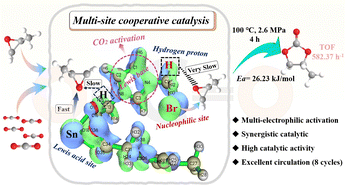
An imidazole-ligated Sn catalyst ([EIMBr-COO]2Sn) with five active centers (i.e., Lewis acidic Sn center, hydrogen atoms of the methylene and methyl groups, the imidazolium cation, and a nucleophilic site Br−) for efficient cycloaddition of epoxides was designed and constructed by combining simulation and cognition. Under mild conditions for only 30 min, the propylene carbonate (PC) yield reached 99.73% with a significant TOF value of 582.37 h−1. [EIMBr-COO]2Sn also demonstrated a wide range of catalytic universality and satisfactory stability. The calculated activation energy (Ea) was much lower at 26.23 kJ mol−1 (6.27 kcal mol−1) compared to those of other reported catalysts. The DFT calculations evidently revealed the efficient catalytic reaction pathway and clearly indicated the promotion mechanism of three electrophilic sites in CO2 cycloaddition. It is elucidated that different electrophilic active sites (i.e., Lewis acid Sn, methylene protons, and methyl protons) interacted with the oxygen atom of epoxides during different reaction states and thus weakened the C–O bond, stabilized the reaction intermediate, and significantly reduced the energy barrier for the CO2 cycloaddition reaction. Informed by the dynamic demands for CO2 cycloaddition, this study employed a sequential strategy of theoretical model construction followed by experimental validation to develop an integrated, high-efficiency catalyst with combined active sites, which established a new paradigm for designing functional catalysts.
 Please wait while we load your content...


