


Design of a ternary heterostructure catalyst composed of waste-derived activated carbon/Fe2O3/reduced graphene oxide for photocatalytic degradation of ciprofloxacin
Abstract
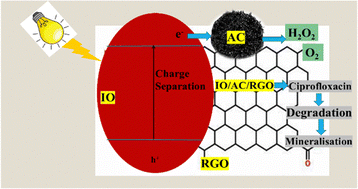
The present study reports the synthesis of a novel binary composite (IO/AC) and a ternary heterostructure (IO/AC/RGO) composed of activated carbon (AC) mediated iron oxide (IO) with reduced graphene oxide (RGO) for the degradation of ciprofloxacin (CIP) under visible light. To the best of the authors’ knowledge, this is the first report on the photocatalytic degradation of CIP using RGO-integrated IO/AC composites. The structural, morphological, and optical characteristics were analyzed using SEM (scanning electron microscopy), TEM (transmission electron microscopy), XRD (X-ray diffraction), FTIR (Fourier-transform infrared) spectroscopy, XPS (X-ray photoelectron spectroscopy), Raman spectroscopy, UV-Vis DRS (UV-visible diffuse reflectance spectroscopy), and PL (photoluminescence) spectroscopy, respectively. The IO/AC/RGO composite demonstrated superior photocatalytic activity, achieving 97% CIP degradation in 120 min, compared to 89% in 140 min by IO/AC, with both processes following pseudo-first-order (PFO) kinetics. Active species scavenger experiments confirmed that hydroxyl (˙OH) and superoxide (˙O2−) radicals were the primary drivers of degradation. Furthermore, the composites exhibited exceptional reusability over five cycles and total organic carbon (TOC) analysis revealed high mineralization efficiencies of 87.3% for IO/AC/RGO and 79.7% for IO/AC. Based on these results, plausible degradation pathways for CIP were proposed. This work demonstrates a highly efficient and robust photocatalyst for the removal of persistent pharmaceutical pollutants from water.
 Please wait while we load your content...


