


Barium carbide – new opportunities in organic synthesis and sustainable acetylene chemistry

Abstract
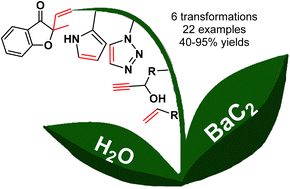
Here, we discuss the potential of barium carbide as a source of gaseous acetylene in organic synthesis for the first time. The reactions of barium carbide with thiols, alcohols, amines, ketones, azides, aldehydes, and aryl iodides were successfully carried out, yielding the desired products with 40–96% yields (6 transformations, 22 examples). The gram-scale procedure for the laboratory-friendly synthesis of barium carbide was developed using barium metal and graphite at 600 °C, resulting in pure BaC2 with a 95% yield. As a result of barium carbide hydrolysis, the strong and water-soluble base Ba(OH)2 was formed. The in situ formation of barium hydroxide was enough for the nucleophilic addition of thiols to acetylene released from barium carbide in the absence of any basic additives. According to DFT calculations, Ba(OH)2 in a DMSO solution exists as a distorted bicapped octahedron with six DMSO molecules and an increased Ba–O distance, confirming the solvate-loose pair nature of barium hydroxide in DMSO solutions. The energy cost of the synthesis of both barium and calcium carbides were calculated and compared. Interestingly, the synthesis temperature of BaC2 from elements was 900 °C lower than that from BaCO3, 1600 °C lower than that for CaC2 from CaCO3, and 500 °C lower than that for CaC2 from elements, making BaC2 a promising industrial source of acetylene.
 Please wait while we load your content...


