


Revealing the catalytic mechanism of CO oxidation on AlN3C-doped graphene: synergistic roles of Al, N, and C

Abstract
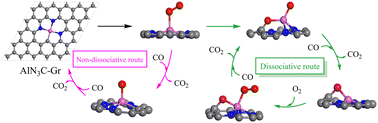
This study employs density functional theory (DFT) calculations to confirm the structural stability of AlN3C–Gr and to elucidate its reaction mechanism toward CO oxidation. The catalyst is found to be thermodynamically and thermally stable without metal aggregation. Adsorption analyses show that O2 preferentially binds to the Al site with moderate strength, while CO exhibits weaker chemisorption and CO2 is physisorbed, preventing CO poisoning and facilitating product desorption. The relative adsorption trend of CO, O2, and CO2 remains unchanged with increasing temperature or partial pressure. Mechanistic investigations reveal that CO oxidation proceeds via two Eley–Rideal pathways: a dissociative route and a nondissociative route, both featuring low activation barriers (0.34–0.43 eV) over 200–500 K. The synergy among Al, N, and the coordinated C fine-tunes the local coordination environment, promoting O–O bond activation and rapid CO oxidation. These results demonstrate that AlN3C–Gr possesses intrinsic low-temperature activity and provide theoretical insights for the rational design of efficient main-group M–N–C catalysts for CO oxidation catalysis.
 Please wait while we load your content...


