


Water molecule transfer equilibrium between hydrated Li+ and Mg2+ to reveal the lithium separation mechanism
 *ab
and
*ab
and
Abstract
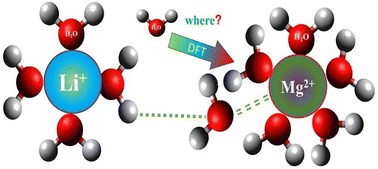
The efficient extraction of lithium from magnesium-rich salt-lake brines is crucial for sustainable lithium production, yet it remains challenging due to the similar physicochemical properties of Li+ and Mg2+. While the tri-butyl-phosphate (TBP) extraction system shows high selectivity for lithium over magnesium, the molecular-level mechanism behind this selectivity remains unclear. Herein, we propose that the differential hydration energy cost, quantified through a water molecule transfer equilibrium between ion hydration clusters, is the key factor governing separation efficiency. Using a consistent density functional theory approach (wB97X-D4/def2-TZVPPD), we systematically computed the solvation structures and stabilities of water clusters, [Li(H2O)n]+ and [Mg(H2O)n]2+. Our results reveal that ion and water molecule interactions in the first hydration sphere are significantly stronger than water molecule interaction in the second hydration sphere. Most notably, equilibrium analysis indicates that under high Mg2+ conditions, the prevailing hydration states are [Li(H2O)4]+ and [Mg(H2O)10]2+. The additional hydration waters around Mg2+ substantially increase the energy penalty for its dehydration upon extraction, thereby explaining the superior selectivity of TBP for Li+. This work not only resolves a long-standing puzzle in lithium extraction but also introduces a general theoretical framework for understanding ionic hydration and selectivity in separation processes.
 Please wait while we load your content...


