


Molecular properties of artificial sweeteners in water
 *ab
Roman
Boča
*b
*ab
Roman
Boča
*b
Abstract
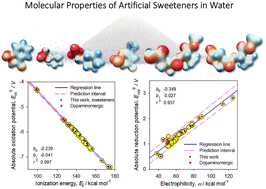
Currently, artificial sweeteners – saccharin, acesulfame, cyclamic acid, and aspartame – are used as food additives. These compounds in their molecular and ionised forms have been studied by quantum chemical methods: the B3LYP hybrid variant of density functional theory and the post-Hartree–Fock DLPNO-CCSD(T) method, which includes a major part of the electron correlation energy. Full geometry optimisation and vibrational analysis were performed using the B3LYP method for neutral molecules, their cations and their anions. For neutral molecules, calculated molecular properties include electronic, electrical, and thermodynamic properties. Calculated ionisation energies and electron affinities were used to predict redox properties – the absolute oxidation and reduction potentials. All data refer to water as a solvent. Three electron–proton transfer mechanisms were investigated for studied systems: (i) the SPLET (Sequential Proton Loss Electron Transfer) mechanism starts with proton transfer (deprotonation) and then continues with electron transfer (oxidation); (ii) the SET-PT (Single Electron Transfer followed by Proton Transfer) mechanism has interchanged steps, so that electron transfer is followed by proton transfer; and (iii) the HAT (Hydrogen Atom Transfer) mechanism assumes simultaneous oxidation and deprotonation. According to the reaction Gibbs energy (B3LYP) and/or total electronic energy (DLPNO-CCSD(T)), the SPLET mechanism is favoured. High ionisation energies prevent the functionality of studied artificial sweeteners as antioxidants.
 Please wait while we load your content...


