


 PLATFORM UPDATE:


Construction of self-supporting bimetallic organic framework electrocatalysts and investigation of their electrocatalytic oxygen evolution reaction performance

Abstract
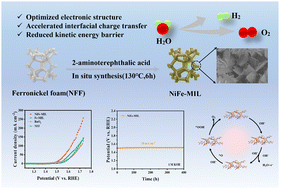
The development of non-precious metal electrocatalysts with high activity and stability is pivotal for advancing water electrolysis technology. Although metal–organic frameworks (MOFs) offer advantages such as tunable structures and well-defined sites, conventional powdered electrocatalysts commonly suffer from issues including deactivation and detachment of active sites, as well as poor conductivity. To address this, this work employs an in situ synthesis strategy on a substrate. Using nickel–iron foam as both a substrate and a metal source and a one-step solvothermal method, arrays of nickel–iron bimetallic MOF nanosheets were successfully grown directly onto the framework surface, constructing a binder-free, self-supporting electrode (NiFe-MIL, MIL stands for Materials Institute Lavoisier). In situ growth ensures robust chemical bonding and efficient electron transfer between the MOF active layer and the conductive substrate, fundamentally eliminating active site shielding and detachment issues caused by insulating binders. The bimetallic synergistic effect optimises the material's electronic structure at the atomic level, effectively modulating the adsorption energy of oxygen-containing intermediates and thereby significantly enhancing the intrinsic activity. Benefiting from this unique structural design, the fabricated NiFe-MIL electrocatalyst exhibits an overpotential of merely 265 mV at 10 mA cm−2 in 1 M KOH electrolyte, with a Tafel slope as low as 41.4 mV dec−1. It also demonstrates impressive electrocatalytic durability. This work not only validates the feasibility of utilising substrates as in situ metal sources for MOF construction but also provides novel insights for designing highly efficient and stable bimetallic electrodes.
 Please wait while we load your content...


