


 PLATFORM UPDATE:


A high-sulfur-loading freestanding SPANI/MWCNT electrode for high-performance lithium–sulfur batteries

Abstract
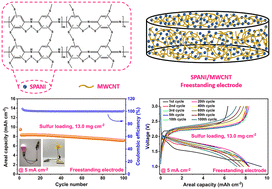
Sulfurized polyaniline (SPANI) serves as a novel advanced cathode material that can chemically immobilize the sulfur active substance via robust intramolecular C–S bonding, thereby eliminating the shuttle effect in conventional lithium–sulfur battery systems. As a result, SPANI can exhibit commendable cycling stability and is compatible with commercial carbonate electrolytes. However, the conductivity of SPANI and its discharge product, Li2S, is exceedingly low, severely hampering the discharge capacity of SPANI at high current rates. To solve this issue, a freestanding SPANI/MWCNT (multi-walled carbon nanotube) electrode with an internal three-dimensional conductive network structure has been successfully constructed for the first time. Compared to traditional coated SPANI electrodes, which deliver only 324.9 mAh g−1 at a high rate of 8C (13 376 mA g−1), the freestanding design enhances the capacity by approximately 1.5 times, reaching 480.5 mAh g−1. Additionally, stemming from the robust mechanical property and the interwoven winding characteristic of MWCNTs, the electrode enables stable operation even with a high sulfur loading of 13.0 mg cm−2, substantially exceeding the feasible limits of the traditional slurry-coating technique. Furthermore, this electrode demonstrates a consistent areal capacity reaching 8.30 mAh cm−2 at a current density of 5 mA cm−2, maintaining 86.4% of its original capacity after 100 charge–discharge cycles. Besides, the freestanding electrode craft can eradicate the need for expensive metal current collectors, binders, and the toxic binder dispersant NMP (1-methyl-2-pyrrolidinone).
 Please wait while we load your content...


