


 PLATFORM UPDATE:


Colorization of optically transparent surfactants to track their movement in biphasic systems used for differentiation of nanomaterials
 a
and
Dawid
Janas
*a
a
and
Dawid
Janas
*a
Abstract
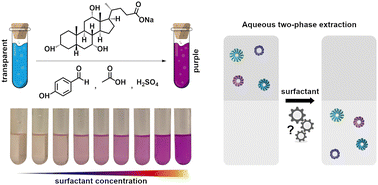
Aqueous two-phase extraction (ATPE) is a versatile method for the purification of numerous chemical compounds and materials, ranging from proteins and nucleic acids to cell organelles and various nanostructures. However, despite its widespread use, the underlying extraction mechanism remains unclear, which significantly reduces the utility of ATPE. Many types of surfactants are often added to biphasic systems to enhance the extraction of analytes between phases. Although their role in this process is crucial, it is not entirely understood. In this work, to fill this gap, we adapt and refine a nearly two-hundred-year-old chemical technique for the detection of bile salts in urine, referred to as Pettenkofer's test and monitor the partitioning of single-walled carbon nanotubes (SWCNTs) by ATPE. This approach enabled us to tint the otherwise transparent bile salt surfactants to precisely track their distribution and concentration in the biphasic system, thereby unravelling the modus operandi of this popular purification technique.
 Please wait while we load your content...


