


 PLATFORM UPDATE:


Synthesis of flame-retardant fluorescent supramolecular polymers for post-combustion fluorescent tracking, cryptographic applications, and eco-friendly invisible fluorescent inks
 *abc
and
*abc
and
Abstract
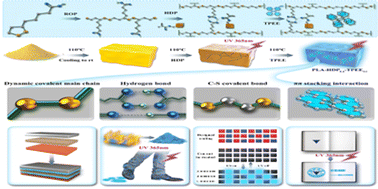
Supramolecular polymer materials derived from biological entities are of paramount importance for the construction of next-generation functional materials. In this study, we employed the flame-retardant monomer HEMA-DPC (HDP) and the aggregation-induced emission monomer (2-(4-vinylphenyl)ethene-1,1,2-triyl)tribenzene (TPEE) to synthesize a novel flame-retardant fluorescent supramolecular polymer material via solvent-free modification of lipoic acid. This is a new strategy for the synthesis and application of double bond addition flame retardant fluorescent lipoic acid supramolecular polymers. Compared with existing lipoic acid polymer materials, this polymer material has a wide range of applications. It serves as a flame-retardant adhesive for fluorescent tracing at post-combustion ash sites. It also acts as a fluorescent encryption material for the encryption of digital information and the decryption of underwater quick response (QR) codes. Furthermore, it can be formulated into a safe, non-toxic, waterproof fluorescent ink, which is cost-effective, environmentally friendly, and holds promise for mass production and widespread application.
 Please wait while we load your content...


