


 PLATFORM UPDATE:


Hierarchical strengthening and toughening design of superalloy joints via a chemically complex intermetallic alloy-modified diffusion bonding strategy
 *abc
*abc
Abstract
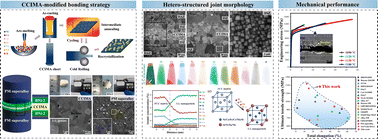
The design and fabrication of advanced interlayer materials are pivotal for the diffusion bonding (DB) of precision and slip-structure turbine components in aero-engines. Here, we developed a chemically complex intermetallic alloy (CCIMA) interlayer exhibiting exceptional mechanical properties at both room and elevated temperatures. Acting as the core of a tailored “BNi-2/CCIMA/BNi-2” sandwich interlayer, the CCIMA plays a critical role in joining powder metallurgy superalloys via the multi-interlayer composite bonding (MICB) strategy. This innovative approach leads to the formation of a robust hetero-structured joint architecture comprising alternating diffusion-affected zones (DAZs), isothermally solidified zones (ISZs), and a central CCIMA region. The CCIMA core, featuring recrystallized L12-ordered grains, critically promotes the extensive precipitation of cuboidal L12-structured nanoparticles within the ISZs. Under the optimized bonding conditions (1150 °C, 2 h), detrimental Nb–Ta-rich borides in the CCIMA region are completely suppressed, while a high-density (∼57 vol%, ∼367 nm diameter) of L12 precipitates forms in the ISZ. The resulting joints achieve an ultimate tensile strength of ∼1325.7 MPa (>93% of the base metal (BM) strength) and elongation of ∼27.7%, which is comparable to the BM's ductility. This outstanding performance is attributed to hierarchical strengthening and toughening mechanisms induced by the CCIMA interlayer, including macroscale strain delocalization enabled by the hetero-structured architecture, microscale dislocation pinning via grain boundaries/serrated bonded interfaces and L12 precipitates, and atomic-level bonding enhancement through tailored diffusion control. This study highlights the critical role of CCIMA as a functional interlayer material, establishing a new paradigm for manufacturing/repairing high-performance turbine components in next-generation aero-engines.
 Please wait while we load your content...


