


 PLATFORM UPDATE:


Nanostructured cellulose ionogels with selective anion confinement for high-efficiency thermoelectric harvesting
 *a
and
Feng
Yan
*ab
*a
and
Feng
Yan
*ab
Abstract
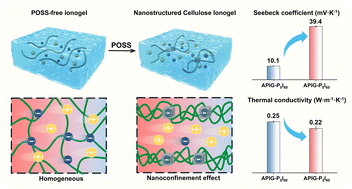
The performance of ionic thermoelectric materials (i-TEs) for low-grade heat harvesting is fundamentally hampered by the coupled transport of ions and heat. Overcoming this to simultaneously achieve high ionic conductivity and low thermal conductivity remains a paramount challenge. We address this by designing a nanostructured ionogel through a thiol–ene click reaction between allyl cellulose and sulfhydryl-functionalized organosiloxanes (POSS-8SH). This creates a microphase-separated architecture with continuous ion-conducting channels. Crucially, the POSS cages serve as multifunctional nodes that selectively nanoconfine anions to widen the cation–anion mobility disparity, while their heterogeneous dispersion effectively scatters phonons to suppress thermal conductivity. Molecular dynamics simulations confirm this mechanism, quantifying a cation diffusion coefficient 5.2 times greater than that of the anion. This strategic decoupling culminates in a high ionic power factor of 15 669.5 µW m−1 K−2. The practical viability of this ionogel was demonstrated by constructing a wearable module that generates 800 mV from body heat. This work establishes a foundational paradigm for advancing thermal energy harvesting and self-powered wearable systems.
- This article is part of the themed collection: Materials Horizons HOT Papers
 Please wait while we load your content...


