


 PLATFORM UPDATE:


Engineered covalent organic framework nanomotor for amplified cuproptosis therapy via Wnt/β-catenin signaling inhibition

Abstract
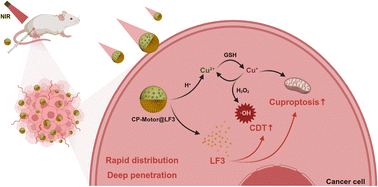
Cuproptosis has emerged as a promising anti-tumor strategy. However, the efficient accumulation of copper ions inside tumors and the copper homeostasis regulatory mechanisms in tumor cells remain challenges for cuproptosis-based cancer therapy. To address these obstacles, we developed a covalent organic framework (COF)-based engineered nanomotor CP-Motor@LF3, which achieved amplified cuproptosis through potent tumor penetration and efficient delivery of the Wnt/β-catenin inhibitor LF3. The engineered nanomotor consists of an Au hemispherical shell and spherical COF carrier co-loaded with copper peroxide (CuO2, CP) and LF3. The ordered hydrophobic porous structure endows the COF carrier with exceptional drug-loading capacity, achieving an LF3 loading amount 3.4-fold higher than mesoporous SiO2. Under 808 nm near-infrared irradiation, the Janus self-thermophoresis nanomotor achieves rapid and deep tumor penetration. CP decomposes in an acidic tumor microenvironment to release Cu2+ for cuproptosis and synergistic chemodynamic therapy. Concurrently, the controlled release of LF3 further amplified the cuproptosis and chemodynamic therapy through inhibiting the Wnt/β-catenin signaling pathway. Consequently, CP-Motor@LF3 exhibits potent anti-tumor activity against bladder cancer both in vitro and in vivo, with post-treatment tumor volumes being 8.67-fold smaller than the control group, demonstrating superior therapeutic efficacy and promising clinical potential.
 Please wait while we load your content...


