


 PLATFORM UPDATE:


A general structural decoupling strategy toward ultra-long blue circularly polarized room-temperature phosphorescence

Abstract
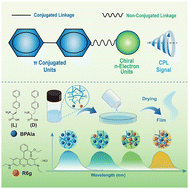
Circularly polarized room-temperature phosphorescence (CP-RTP) materials are highly sought after for 3D displays and information encryption, yet achieving high-performance blue emission remains a formidable challenge due to the intrinsic trade-off between triplet energy (ET) and spin–orbit coupling (SOC) efficiency. Conventional molecular designs incorporating heteroatoms into conjugated systems to enhance SOC often lead to stabilized excited states and red-shifted emission. Herein, we propose a “structural decoupling” strategy by employing a non-conjugated methylene (–CH2–) bridge between chiral n-electron units and the π-conjugated backbone. This design effectively interrupts electronic conjugation, shifting the dominant excited-state character from low-energy n → π* to high-energy π → π*, thereby preserving high ET for blue emission while maintaining efficient SOC via spatial proximity. Using D/L-4,4′-biphenylalanine (D/L-BPAla) as a model, we demonstrate that the structural decoupling strategy preserves the high ET of the biphenyl unit. D/L-BPAla-doped PVA films exhibit blue CP-RTP (475 nm) with an exceptional lifetime of 2.91 s, a phosphorescence quantum yield of 9.10%, and an asymmetry factor (glum) of 3.75 × 10⁻³. This work provides a generic blueprint for developing high-energy, long-lived organic chiroptical materials by surmounting the ET-SOC trade-off.
 Please wait while we load your content...


