


 PLATFORM UPDATE:


Photoresponsive hydrogels using phototherapy to accelerate wound healing: correlating mechanisms with clinical effects

Abstract
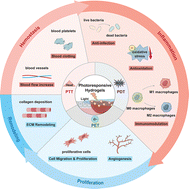
Chronic wounds feature persistent inflammation and impaired regeneration, creating major clinical and economic burdens that have motivated the development of active wound dressings that can guide the healing process rather than merely providing passive protection. Photoresponsive hydrogels (PRHs) have recently emerged as promising candidates in this regard by enabling noninvasive, spatiotemporally controlled therapeutic effects under light. While photodynamic therapy (PDT) and photothermal therapy (PTT) have been extensively studied, the role of photoelectric therapy (PET) in wound healing has only recently gained attention, leaving a gap in mechanistic understanding and clinical translation. Accordingly, this review connects material-level photoconversion mechanisms underlying PTT, PDT and PET (generation of heat, ROS and photoelectrons) with their biological response mechanisms (e.g., anti-infection, immunomodulation, angiogenesis and cell migration/proliferation). We further summarize recent advances in PRH design and explore their therapeutic roles throughout the wound-healing process (including hemostasis, inflammation, proliferation, and remodeling), emphasizing stage-specific regulation of PRHs through tunable irradiation and microenvironment-adaptive designs. Finally, we discuss current challenges for PRHs from phototherapy-mode and clinical-translation perspectives, together with future directions. By correlating mechanisms with clinical effects, this review aims to bridge the gap between fundamental research and clinical application, guiding rational PRH design for more effective wound management.
- This article is part of the themed collection: Recent Review Articles
 Please wait while we load your content...


