


Programming magnetic composites and phase change materials for multimodal haptic interfaces with integrated self-sensing toward adaptive and proprioceptive haptic feedback

Abstract
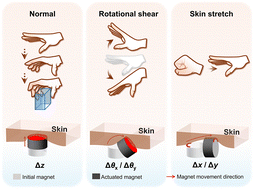
Advancements in wearable human–machine interfaces require haptic systems that are mechanically compliant, functionally versatile, and capable of delivering rich tactile and proprioceptive feedback under varying interaction conditions. However, existing haptic devices are often constrained by bulky structures, rigid components, insufficient actuation modalities, and the absence of self-sensing capabilities, which restrict their wearability, responsiveness, robustness, and seamless integration with the human body. This work presents multimodal, self-sensing, haptic interfaces enabled by programmable soft magnetic composites and phase change materials, which provide three distinct working modes (normal, rotational shear, and skin stretch) within a compact, skin-conformal form factor. The haptic interface leverages soft magnets with programmable magnetization profiles to enable multimodal actuation. Hybrid electromagnetic coils, incorporating both solenoid and planar configurations fabricated with stretchable gallium-based conductors, are designed to enhance stretchability and actuation output. Combined with a Kirigami-patterned elastomeric spring, the haptic actuator generates forces and displacements that exceed human tactile perception thresholds while maintaining performance under deformation. Furthermore, the inductance-based self-sensing mechanism provides real-time displacement monitoring for closed-loop control, ensuring consistent performance across varying actuation and interaction conditions. Ultimately, our soft multimodal haptic device can facilitate selective stimulation of multiple cutaneous mechanoreceptors and has been demonstrated to accurately encode both limb spatial position and joint motion for comprehensive proprioceptive feedback.
 Please wait while we load your content...


