


 PLATFORM UPDATE:


Porosity and basicity tuned biomass-derived activated carbon enhancing CO2 capture

Abstract
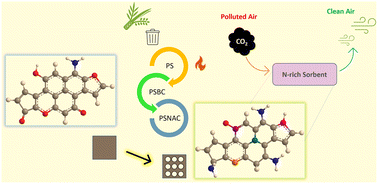
The dual challenges of excessive carbon dioxide emissions and the accumulation of agricultural biomass waste pose significant environmental concerns. A sustainable solution lies in repurposing biomass-derived materials for CO2 mitigation. Biomass wastes are one of the primary sources of carbonaceous materials, and with a rational synthetic strategy, these substrates can be turned into a cost-effective solution for CO2 capture. In this work, we develop a nitrogen-doped activated carbon-based sorbent from peanut shells, optimizing its porosity and basicity for selective CO2 adsorption. Peanut shell, a lignocellulose carbonaceous biomass, can be transformed into a porous, CO2 specific adsorbent through a two-step synthesis. By optimizing porosity and basicity, peanut shell-derived nitrogen-doped activated carbon synthesised at 700 °C (PSNAC700) emerged as the best adsorbent, exhibiting an exceptional uptake of 9.78 mmol g−1 in an ultra-dilute CO2 stream (5000 ppm). Operando studies reveal the deformation in CO2 geometry upon strong adsorbate–adsorbent interactions. Life cycle assessment (LCA) further validates the overall technology as carbon-negative, with the implementation of a renewable energy source for regeneration, aligning with net-zero climate targets.
 Please wait while we load your content...


