


Redefining molecular design and exciton dynamics in single-component organic photocatalysts for efficient solar-to-hydrogen conversion

Abstract
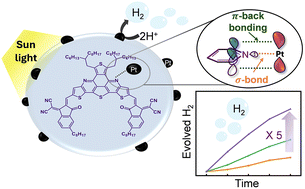
A major challenge in organic single-component photocatalysts (SCPCs) for hydrogen (H2) generation is their intrinsically inefficient exciton separation and charge generation. To address this, we designed two thienopyridine-fused benzodithiophene (TPBDT) molecules, TPBDT-2FIC and TPBDT-INCNO1, featuring wide bandgaps, extended coplanar π-conjugated backbones, and small Stokes shifts to improve molecular packing and exciton diffusion. TPBDT-INCNO1 incorporates a cyclic imine group that enables strong coordination with Pt co-catalysts through Pt–N σ- and π-bonding interactions. The electron density on the imine nitrogen is successfully tuned to facilitate efficient Pt deposition. Molecular dynamics simulations and X-ray scattering analyses confirm enhanced core–core interactions and improved packing of TPBDT-INCNO1 in nanoparticles (NPs) compared to Y6. This tight packing, along with a small SS, leads to efficient exciton diffusion to the NP surface with an extended exciton lifetime (1.66 ns). Approximately 70% of excitons are quenched via rapid hole transfer (∼1 ns) to L-ascorbic acid, generating long-lived electrons that are effectively quenched by Pt. As a result, TPBDT-INCNO1-based NPs exhibit high hydrogen evolution rate of 102.5 mmol h−1 g−1, significantly outperforming the Y6 reference. This study demonstrates key molecular design strategies for advancing SCPCs for efficient solar-driven H2 production.
- This article is part of the themed collection: Materials Horizons HOT Papers
 Please wait while we load your content...


