



Chiral-polarized photonic chips via organic crystal heterojunctions
 c
and
Chun-Lin
Sun
*b
c
and
Chun-Lin
Sun
*b
Abstract
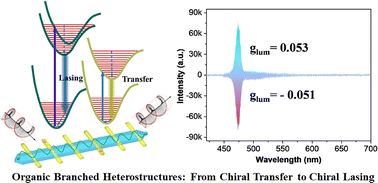
Organic photonics is a vibrant research field that harnesses the unique optical properties of organic small molecules and polymers, offering significant potential for applications in displays, sensors, and quantum communication. However, single-component materials are increasingly inadequate for meeting the demands of complex optical functionalities. In this study, we have fabricated organic branched heterostructures (OBHs) via a sequential process combining lattice-matched epitaxial growth and controlled stepwise crystallization. The structure consists of a laser gain medium as the main chain, with branches made from energy receptor molecules that possess efficient waveguide properties. The excitation dipole moments between the main chain and the branches are aligned at a fixed, well-defined angle, enabling the integration of organic laser materials with complex waveguide functions while maintaining excellent polarization retention properties. Under circularly polarized light excitation, the heterostructure demonstrates remarkable circularly polarized laser emission (|glum| = 0.05) from the trunk and chiral transmission (|glum| = 0.03) to the branch. Our work demonstrates that the rational design of OBH structures provides an innovative strategy for circularly polarized laser design and opens new avenues for research in chiral photonic chips.
 Please wait while we load your content...


