


 PLATFORM UPDATE:

Molecular-switch-embedded organic Schottky barrier transistors for a high switching ratio

Abstract
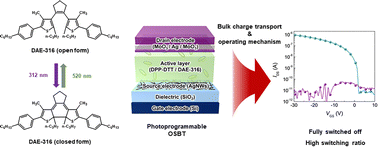
Research on organic semiconductors has increasingly focused on developing multifunctional devices, leveraging their inherent advantages such as lightweight properties, low-cost fabrication, and tunable optoelectronic characteristics. Within this context, the exploration of molecular switches, particularly diarylethenes (DAEs), for precise current modulation in transistors has garnered significant interest. While the optimal molecular switch design has been extensively studied, advancements in transistor architecture have remained limited. This work introduces a novel approach utilizing organic Schottky barrier transistors (OSBTs), a type of organic vertical transistor featuring a distinct operation mechanism in terms of conductive channel formation and charge injection, enabling superior hole-trapping efficiency compared with conventional organic field-effect transistors (OFETs). By incorporating a dielectric/metal/dielectric transparent electrode to mitigate light-irradiation limitations, we successfully integrated DAEs into OSBTs, achieving a record-high photoprogrammable switching ratio exceeding 6.4 × 10⁴ at a 30 wt% DAE concentration. The physics underlying the superior performance of OSBTs compared to that of OFETs is explained, with a focus on the distinct gate-field effect. Furthermore, stable switching performance was maintained over 100 repeated cycles, demonstrating exceptional fatigue resistance. This innovative architecture paves the way for the development of high-performance photoprogrammable transistors.
 Please wait while we load your content...


