


Ion-pair receptors based on tripodal building blocks: perspective on cooperative recognition and extraction of inorganic salts
 *ab
and
Arghya
Basu
*c
*ab
and
Arghya
Basu
*c
Abstract
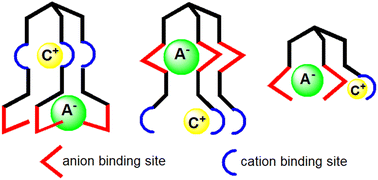
A primary objective in supramolecular chemistry is the development of molecular host systems capable of specific ion-pair recognition. The current emphasis of this research is the strategic molecular design of receptors to achieve superior binding affinities and enhanced selectivity for a specific ion-pair. The concept of ion-pair recognition has evolved from the basic understanding of cation and anion recognition chemistry and has gradually developed into a dynamic sub-discipline of supramolecular chemistry. Among the various classes of synthetic receptor systems, tripodal receptors are particularly noteworthy for ion-pair recognition due to their inherent symmetry and the ease with which their structures can be tuned for host–guest interactions through the strategic incorporation of cation and anion binding groups. This review focuses on ion-pair receptors built upon tripodal scaffolds, examining their binding behaviour primarily towards inorganic salts and the intricate structure–function relationships that govern their cooperative cation and anion binding performances. Specifically, we provide a comprehensive analysis of the solid-state structures of ion-pair complexes and the solution-phase binding affinities of a diverse range of C3-symmetrical and asymmetrical tripodal receptors, offering insights into their capabilities for selective ion-pair binding and their potential applications in inorganic salt extraction from competitive aqueous media.
 Please wait while we load your content...


