


 PLATFORM UPDATE:


Regioselective triclocarban-catalyzed synthesis of spiroindeno- and spirooxindolo-pyrrolizidines with apoptosis induction in MCF-7 cells
 a
and
Srinivas
Basavoju
*a
a
and
Srinivas
Basavoju
*a
Abstract
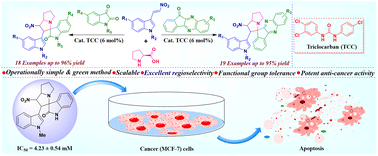
The design of new molecules from known structural motifs via [3 + 2] cycloaddition is a widely used strategy in modern drug discovery. Herein, an efficient, eco-friendly synthesis of spiroindeno- and spirooxindolo-pyrrolizidine derivatives is reported using triclocarban as an organocatalyst in ethanol, affording 80–96% of yields within 1.4 h with excellent regioselectivity. The synthesized compounds were evaluated for in vitro cytotoxicity against human cancer cell lines and normal HEK-293 cells. Among them, compound 6b exhibited significant antiproliferative activity against MCF-7 cells (IC50 = 4.23 ± 0.54 μM), while none of the compounds showed toxicity toward normal cells. Biological investigations suggest that compound 6b induces apoptosis, which is potentially associated with mitochondrial membrane depolarization, ROS generation, DNA damage, nuclear morphological changes and inhibition of cell migration. Molecular docking and dynamics simulations suggested stable binding of compound 6b to NQO2, while ADMET analysis indicated favourable pharmacokinetic properties.
 Please wait while we load your content...


