


A halogenated pregnenolone analogue suppresses HepG2 proliferation and induces apoptosis via PPARγ regulation
 *ab
*ab
Abstract
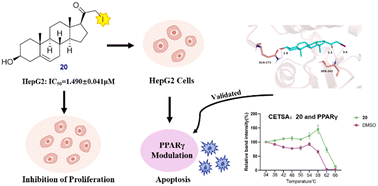
The broad biological activity of synthetic halogenated steroid derivatives has spurred considerable recent research. In this study, we synthesized and evaluated cytotoxicity against HepG2 cells for twenty-eight halogen-containing pregnenolone derivatives. Compound 20 exhibited the highest cytotoxicity, with an IC50 value of 1.490 ± 0.041 μM. It effectively inhibited cell proliferation, clone formation, and migration, as well as induced DNA damage in hepatocellular carcinoma cells. Flow cytometry revealed that compound 20 induced G0/G1 cell cycle arrest. Concurrently, experimental evidence from Hoechst 33258 staining, flow cytometry, and western blotting convincingly demonstrated that compound 20 robustly promotes apoptosis in HepG2 cells, marked by decreased expression of pro-survival proteins (caspase 3/8/9, Bcl-2) and increased expression of pro-apoptotic Bax. Network pharmacology identified PPARγ as a key potential target. Western blots using a PPARγ agonist (pioglitazone) and antagonist (T0070907) validated its crucial role in mediating compound 20-induced apoptosis in HepG2 cells. Complementary molecular modeling, including docking and molecular dynamics simulations, underscored the high binding affinity and stabilizing interaction between compound 20 and PPARγ. Furthermore, a CETSA assay provided additional support, confirming that compound 20 enhances PPARγ's thermal stability. Collectively, these findings strongly suggest that compound 20 inhibits HepG2 proliferation and promotes HepG2 apoptosis via PPARγ modulation, positioning it as a promising lead compound for hepatocellular carcinoma treatment.
 Please wait while we load your content...


