


Parallels between the chloro and methoxy groups for potency optimization
 †a
and
Yoshihiro
Ishihara
*b
†a
and
Yoshihiro
Ishihara
*b
Abstract
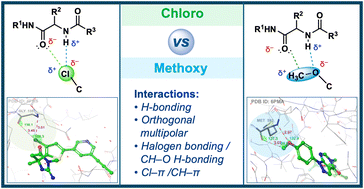
Small substituents such as chloro (Cl), fluoro, methyl, and methoxy (OCH3) are often used in drug discovery to optimize ligand–protein interactions. Even though Cl is an electron-withdrawing group and OCH3 is an electron-donating group exerting opposite effects on an aromatic ring, Cl and OCH3 also display similarities in that they both exhibit dual electrostatic behavior. In a C–Cl bond, Cl is electronegative and adopts negative electrostatic potential, but at the same time, it has a σ-hole that is depleted of electron density and has an area of positive electrostatic potential. Similarly, the oxygen atom of OCH3 displays negative electrostatic potential, but inductive electron-withdrawing effects bestow positive electrostatic potential at the terminal methyl group. This dual nature allows a versatile interaction with partially positive (δ+) and partially negative (δ−) regions of a protein pocket. In this study, four main types of intermolecular interactions are discussed from the vantage point of Cl and OCH3 substituents: 1) hydrogen bonding, 2) orthogonal multipolar interactions, 3) halogen bonding and CH–O hydrogen bonding, and 4) Cl–π bonding and CH–π bonding. A comprehensive search of the PDB and analysis of X-ray co-crystal structures for each type of interaction unveiled parallels between Cl and OCH3 in the manner in which these substituents engage with amino acid residues. The opposing electronic effects of Cl and OCH3 substituents on an aromatic ring, along with the dual electrostatic versatility of these two groups, render them useful scouts to probe protein pockets for potency optimization.
 Please wait while we load your content...


