


 PLATFORM UPDATE:


LLDT-8 attenuates brain metastasis in non-small cell lung cancer via selective p53 activation

Abstract
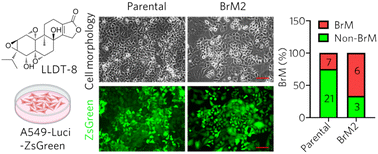
Brain metastasis (BM) remains a leading cause of mortality in non-small cell lung cancer (NSCLC) owing to inadequate blood–brain barrier (BBB) penetration and therapy resistance. Here, we developed a brain-tropic A549-BrM2 subline that recapitulates aggressive BM progression and employed it to evaluate LLDT-8, a C14-hydroxylated derivative of triptolide for enhanced BBB permeability. In vitro, LLDT-8 exhibited attenuated cytotoxicity relative to triptolide, yet selectively induced p53-mediated apoptosis in BrM2 cells, an effect absent in parental lines. Transcriptomic profiling revealed that LLDT-8, unlike triptolide, upregulates Tp53 without robustly inducing its negative regulator Mdm2, thereby enabling preferential p53 protein accumulation and activation in the metastatic niche. In vivo, LLDT-8 significantly suppressed BM growth, achieving superior intracranial tumor control compared to triptolide, while eliciting no detectable systemic toxicity. These results identify LLDT-8 as a metastasis-selective agent that merges enhanced brain bioavailability with precise p53 pathway activation, providing a promising therapeutic strategy for NSCLC-derived BM.
 Please wait while we load your content...


