


 PLATFORM UPDATE:


Unravelling the antibacterial performances of a homochiral d-configured tetraphenylalanine appended 16-HPA derivative based mechanoresponsive and proteolytically stable hydrogel

Abstract
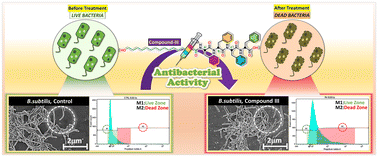
Microbial infection is one of the most pressing global challenges worldwide, and imposes significant economic burdens on healthcare systems. This work represents a rational combinatorial strategy that leverages hydrophobic harmony in multiple phenylalanine fragments, anchored to an amphiphile 16-hydroxy-palmitic acid at the N-terminus (16-HPA-D-Phe-D-Phe-OH, compound I; 16-HPA-D-Phe-D-Phe-D-Phe-OH, compound II; 16-HPA-D-Phe-D-Phe-D-Phe-D-Phe-OH, compound III), such that a viable therapeutic skeleton could be uncovered through this strategy. In pursuit of this objective, the minimum inhibitory concentrations of compounds I–III were investigated using four distinct microorganisms namely Staphylococcus aureus and B. subtilis (Gram positive), and E. coli and P. aeruginosa (Gram negative). Our systematic examination reflected that from a pool of three skeletons, compound III comprising of D-configured tetraphenylalanines displayed not only mechanoresponsive assisted hydrogelation propensities at physiological pH, but also excellent antibacterial activities in vitro, in the Gram positive micro-organisms backed by molecular modelling studies. Henceforth compound III was selected from the design and proceeded for its elaborate antibacterial activities using colony counting experiment, bacterial scanning electron microscopy and live–dead assay using flow cytometry. Furthermore, the β-sheet structured compound III, stabilized by weak non-covalent interactions, depicted optimum mechanical strength as well as proteolytic stability for 72 h when exposed to the proteolytic enzyme, proteinase K and chymotrypsin. Overall, our analysis highlights the potential of compound III as a promising candidate for future antimicrobial therapy. However, further experiments are necessary to validate these findings, and current claims are reflective of an early proof-of-concept until further preclinical data are available.
 Please wait while we load your content...


