


 PLATFORM UPDATE:


Activated clay/Opuntia microdasys incorporated polyvinyl alcohol membranes for fouling mitigation in wastewater filtration

Abstract
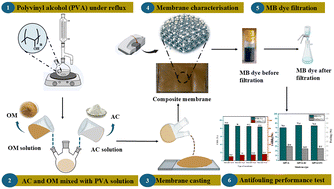
Membrane technology in water treatment is evolving rapidly, yet persistent challenges such as low selectivity, poor antifouling and inadequate contaminant recovery still limit its broader application. In this study, a sustainable membrane fabrication strategy integrating polyvinyl alcohol (PVA) with activated clay (AC) and Opuntia microdasys (OM) was developed to enhance ultrafiltration performance for dye–laden wastewater. Composite membranes were prepared via solution casting process and crosslinked with urea–formaldehyde to improve stability. Structural and surface properties were characterised using SEM-EDS, FTIR, 1H NMR, XRD, and ZETA-sizer. The incorporation of OM in addition to AC introduced surface porosity and hydrophilicity, enabling a dual-action mechanism of size exclusion and surface interaction for fouling control. The optimized composite membrane, MAC1:OM1, achieved 68.0% porosity and 67.5 L m−2 h−1 pure water flux (PWF) significantly outperforming the neat PVA membrane (52.1% porosity, 55.4 L m−2 h−1 PWF). A 29.7% increase in dye removal efficiency (RE) from 54.6% to 84.3% and a 56.4.% reduction in fouling (from 29.6% to 12.9%) were recorded. The flux recovery ratio (FRR) improved from 70.4% to 87.1%, indicating superior antifouling properties. This work highlights the synergistic role of natural fillers in engineering next-generation ultrafiltration membranes for efficient and eco-friendly wastewater remediation.
 Please wait while we load your content...


