


Tunable squeeze-activated GHz acoustofluidics for stable trapping and separation of sub-100 nm nanoparticles

Abstract
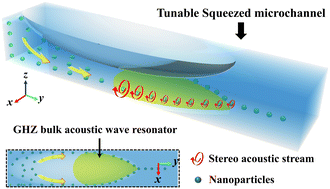
The precise enrichment and size-selective separation of sub-100 nm biological nanoparticles such as exosomes remain challenging due to their small size and heterogeneity. Conventional GHz acoustofluidic systems suffer from unstable acoustic streaming vortices at channel entrances, leading to particle leakage and limited trapping efficiency. Here, we present a tunable squeeze-activated GHz acoustofluidics (TSGA) platform that overcomes these limitations through dynamic and symmetric deformation of the microchannel. By adjusting pneumatic pressure and acoustic power in real time, the system enables on-demand modulation of the acoustic streaming field and particle migration paths. The squeeze-induced arched profile guides nanoparticles toward stable vortex regions while enhancing their exposure frequency to high-gradient acoustic radiation force. This programmable mechanism allows continuous enrichment of particles down to 50 nm, achieving a single-round enrichment factor of 2.38 for 150 nm particles with >75% recovery efficiency. Moreover, through coordinated pressure-acoustic tuning, a multistage separation strategy successfully isolates 77 nm particles from complex mixtures, increasing purity from 30.3% to 80.6%, and purifies exosome subpopulations with high resolution. The TSGA platform provides a robust, label-free, and dynamically tunable approach for scalable nanoscale bioparticle processing, promising advances in exosome research and liquid biopsy diagnostics.
 Please wait while we load your content...


