An in vitro organ-on-chip model for studying neuron–keratinocyte interactions in sensory response through electrophysiology

Abstract

This study introduces a human-relevant in vitro model using iPSC-derived sensory neurons and keratinocytes in MEA-integrated microfluidic chips. Neurons expressed nociceptor markers, showed TRPV activity, and formed contacts with keratinocytes. Stimuli evoked electrophysiological responses, highlighting neuron–keratinocyte interactions relevant to pruritus, pain, and skin disorders, supporting therapeutic development.
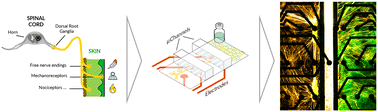
Graphical abstract: An in vitro organ-on-chip model for studying neuron–keratinocyte interactions in sensory response through electrophysiology

Supplementary files

Article information

Article type
Communication
Submitted
12 Sep 2025
Accepted
26 Nov 2025
First published
03 Dec 2025

Lab Chip, 2026, Advance Article

An in vitro organ-on-chip model for studying neuron–keratinocyte interactions in sensory response through electrophysiology

T. Bessy, A. Martinez, C. Baquerre, C. Grégoire, A. Batut, A. Berthelin, L. Dubuisson, S. Teluob, A. Azéma, L. R. Berlier, D. Lelièvre and A. Guichard, Lab Chip, 2026, Advance Article , DOI: 10.1039/D5LC00867K

To request permission to reproduce material from this article, please go to the Copyright Clearance Center request page.

If you are an author contributing to an RSC publication, you do not need to request permission provided correct acknowledgement is given.

If you are the author of this article, you do not need to request permission to reproduce figures and diagrams provided correct acknowledgement is given. If you want to reproduce the whole article in a third-party publication (excluding your thesis/dissertation for which permission is not required) please go to the Copyright Clearance Center request page.

Read more about how to correctly acknowledge RSC content.

Social activity

Spotlight

Advertisements