


 PLATFORM UPDATE:


Development and application of a raster-spot model in Galvo-fsLA-ICP-MS for precise trace-element and U–Pb isotopic analysis
 *a
Xiaoping
Xia,
a
*a
Xiaoping
Xia,
a
Abstract
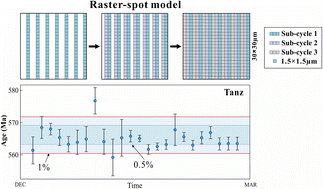
Laser ablation inductively coupled plasma mass spectrometry (LA-ICP-MS) with femtosecond (fs) laser sources offers significant advantages in reducing elemental fractionation and matrix effects compared to nanosecond systems. However, conventional galvanometer-scanned femtosecond laser ablation (Galvo-fsLA) systems suffer from rapid signal decay (90–97% within 20 seconds), limiting their application for analyses requiring sustained stable signal output. Here, we introduce a novel raster-spot model for Galvo-fsLA systems that fundamentally restructures the ablation sequence by decomposing individual scanning layers into discrete sub-cycles. This approach achieves ablation with minimal elemental fractionation, while drastically reducing signal decay. Scanning electron microscopy reveals that the raster-spot model produces craters with notably flatter bases and smoother walls. Quantitative trace element analysis of 42 elements in five reference materials, OA-1, OH-1, OJY-1, BHVO-2G, and NKT-1G, demonstrates relative errors and relative standard deviations predominantly below 15%. For U–Pb geochronology, the raster-spot model achieves exceptional accuracy with relative errors of less than 0.5% for zircon standards (Tanz, SA01, Plešovice) and other accessory minerals (apatite, monazite, rutile, allanite, and titanite). Optimal optical focusing is also critical, with deviations as small as ± 20 µm degrading the accuracy from −0.2% to −1.3%. The raster-spot model represents a significant advancement in Galvo-fsLA-ICP-MS methodology, enabling high-sensitivity, long-duration analyses with superior accuracy for both trace element quantification and U–Pb dating across diverse geological materials.
 Please wait while we load your content...


