


Comparative analysis of 532 nm vs. 1064 nm wavelengths for nitrogen detection in water using plasma amplification LIBS

Abstract
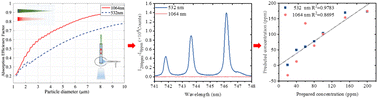
Based on a water-soluble aerosol sampling system, plasma amplification laser-induced breakdown spectroscopy (plasma amplification LIBS) has shown great potential for determining nitrogen (N) in water due to its high sensitivity, precision, and accuracy. Water-soluble aerosols absorb 1064 nm laser radiation much more strongly than 532 nm radiation, less laser energy contributing to plasma formation. Therefore, the influence of laser wavelength on the quantitative determination of nitrogen in water was systematically investigated. When the 532 nm laser wavelength was used, stronger spectral line intensity, lower interference from atmospheric nitrogen, and superior analytical performance were obtained. As a result, the linear coefficient of determination (R2) of the calibration curve improved from 0.2147 to 0.9732, the limit of detection (LOD) reduced from 18.98 ppm to 3.41 ppm, and the spectral stability, expressed as average relative standard deviation (RSDAV), reduced from 10.49% to 5.45%. Moreover, the average relative error (REAV) and the root mean square error of cross-validation (RMSECV) for the predicted concentrations improved by approximately 56.82% and 71.79%, respectively. Thus, 532 nm significantly enhances the detection sensitivity and accuracy of plasma amplification LIBS. This work establishes a wavelength-dependent relationship between aerosol absorption, plasma formation, and analytical performance.
 Please wait while we load your content...


