


 PLATFORM UPDATE:


Highly accurate classification of herbals relying on toxic elements via laser-induced breakdown spectroscopy and chemometrics
 *a
*a
Abstract
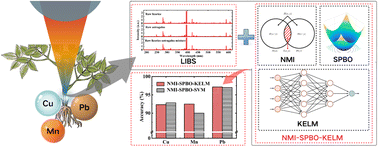
Herbals play a crucial role in maintaining human health owing to their therapeutic properties. However, herbals with excessive copper (Cu), manganese (Mn), and lead (Pb) are common due to pollution. Conventional detection methods for toxic elements are time-consuming and prone to contamination. Laser-induced breakdown spectroscopy (LIBS), a technology based on plasma analysis, offers rapid detection. Combining LIBS with chemometrics has become a popular approach for herbal detection. However, identifying toxic elements remains challenging due to difficulties in extracting relevant spectral variables. This study proposed using normalized mutual information (NMI) for variable extraction, while the student psychology-based optimization (SPBO)-kernel extreme learning machine (KELM) was used to classify herbals based on Cu, Mn, and Pb contents. The results showed that the number of extracted variables was only 0.018%, 0.073%, and 0.66% of total variables. Compared with principal component analysis-KELM, NMI-KELM improved average accuracy and F1 by 5.00% and 2.87%. With SPBO optimization, NMI-KELM's average accuracy and F1 increased to 94.00% and 93.14%. This study provided a foundation for the rapid and accurate classification of herbals based on toxic element content.
 Please wait while we load your content...


