


 PLATFORM UPDATE:


Investigating the impact and mechanisms of integration time on LIBS repeatability and plasma parameter inversion results
 *ab
*ab
Abstract
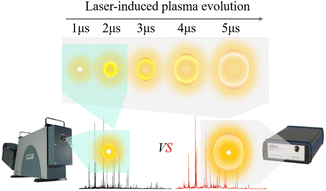
Although a longer integration time can enhance the spectral intensity, it also obscures more information regarding plasma evolution. In this study, laser-induced plasma (LIP) is detected simultaneously by using both long-integration-time and short-integration-time spectrometers via a Y-shaped fiber, and the effect of integration time on the repeatability and the inversion of plasma parameters for laser-induced breakdown spectroscopy (LIBS) spectra is investigated. The results reveal that (1) the radiation decay rate at the same wavelength varies among different LIPs, leading to increased differences in line intensities with longer integration times. However shorter integration times theoretically improve repeatability, in fact, shorter integration times tend to improve the repeatability of strong emission lines, but reduce the repeatability of weak emission lines by reducing their signal-to-background ratios (SBRs) and signal-to-noise ratios (SNRs). (2) The radiation decay rates at different wavelengths also vary within the same plasma, causing further increases in spectral line intensity differences with longer integration times. This results in greater vertical dispersion of data points in Boltzmann or Saha–Boltzmann plots, leading to underestimated plasma temperatures. (3) Longer integration times may also lead to underestimation of electron densities derived from the Stark broadening method. This study provides significant guidance for optimizing LIBS integration parameters, improving repeatability and advancing plasma spectral diagnostics.
 Please wait while we load your content...


