


 PLATFORM UPDATE:

Access to indole-3-urea/carbamate derivatives via rhodium-catalysed Lossen rearrangement: a uniform and safe protocol
 *ab
*ab
Abstract
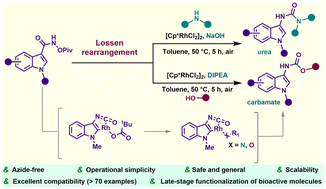
In recent years, indole-3-urea/carbamate derivatives have emerged as privileged scaffolds in drug discovery campaigns. Their synthesis commonly involves the use of indolyl isocyanates, typically generated via DPPA-mediated Curtius rearrangement of indole-3-carboxylic acids. Although versatile and widely employed, DPPA relies on toxic and explosive sodium azide during preparation and poses intrinsic hazards, making it a non-eco-friendly option that violates green chemistry principles. Herein, we report a rhodium-catalysed Lossen rearrangement under mild reaction conditions, enabling facile access to indole-3-urea/carbamate derivatives in an azide-free manner. The broad functional group compatibility (74 examples), scalability, and late-stage functionalization of bioactive compounds illustrate a robust and safe method to construct indole-3-urea/carbamate compound libraries.
 Please wait while we load your content...


