


An emulsifier- and organic solvent-free one-step method for fabricating nano-encapsulated phase change materials

Abstract
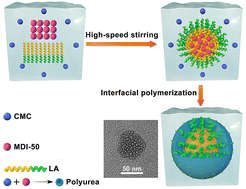
The fabrication of nano-encapsulated phase-change materials (NePCMs) via one-step methods without the requirement for emulsifiers or organic solvents remains a significant challenge. Herein, an emulsifier- and organic solvent-free one-step method is introduced for the fabrication of NePCMs. For this purpose, lauric acid (LA), which can self-emulsify in water, was used as the PCM core. An oil-soluble component (diphenylmethane diisocyanate-50) and a water-soluble component (carboxymethyl chitosan) reacted at the oil–water interface of the LA emulsion to generate the polymer shell of the NePCM through interfacial polymerization. The resulting NePCM exhibited a unique interpenetrating core–shell structure, with an average particle size of 44.5 nm. The NePCM demonstrated a high encapsulation efficiency of 96.3% and melting and crystallization enthalpies of 101.7 and 100.5 J g−1, respectively. Additionally, the NePCM showed excellent thermal reliability and good thermal stability. This method therefore represents a green and facile approach for the preparation of functional nanomaterials.
 Please wait while we load your content...


