


Sustainable conversion of lignocellulose hydrolysates without detoxification treatment to biodegradable poly(3-hydroxybutyrate) by a Halomonas venusta DSM4743 cell factory
 *a
*a
Abstract
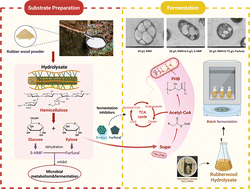
The use of lignocellulosic biomass resources as substrate feedstock has become an effective way to reduce polyhydroxyalkanoate (PHA) production costs. In this work, poly(3-hydroxybutyrate) (PHB) was synthesized using Halomonas venusta DSM4743 with rubberwood hydrolysates (RWHs) without detoxification treatment as the carbon substrate. Compositional analysis revealed that glucose (61.3 g L−1) was consumed more efficiently than xylose (19.6 g L−1), confirming preferential carbon utilization in RWHs. The highest PHB production of 1.23 g L−1 was achieved at an initial RWH concentration of 20 g L−1. Notably, the tolerance thresholds of Halomonas venusta DSM4743 to furfural and 5-HMF in RWH were identified as 0.75 g L−1 and 0.6 g L−1, respectively. Low-concentration furfural was found to enhance glucose and xylose utilization rates by 15.81% and 30.51%, alleviating glucose inhibition, but simultaneously suppressed PHB biosynthesis. In contrast, 5-HMF supplementation promoted late-stage xylose consumption but inhibited microbial growth. Under optimized conditions, the synthesized PHB exhibited a tensile strength of 17.17 MPa. Compared to commercial PHB, the polymer derived RWH displayed a uniform molecular weight distribution, reduced melting temperature, and improved processability, highlighting its suitability for industrial applications. This study provides a sustainable pathway for efficiently utilizing agro-forestry biomass resources and advancing cost-effective PHA industrialization.
- This article is part of the themed collection: Advanced Eco-Manufacturing and Sustainable Bioproducts with Lignocellulosic Biomass
 Please wait while we load your content...


