


Molecular simulation in cellulose dissolution: mechanisms, green solvent design, and future directions
 *a
*a
Abstract
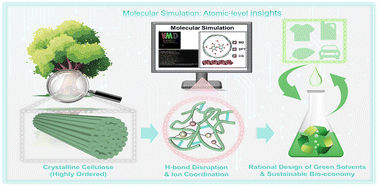
Molecular simulation techniques have significantly advanced our understanding of cellulose dissolution mechanisms, providing atomic-level insights that are challenging to obtain experimentally. This review summarizes recent progress in applying molecular dynamics (MD), density functional theory (DFT), and coarse-grained (CG) models to elucidate the interactions between cellulose and various solvents. We emphasize the role played by molecular simulation in decoding the behavior of green solvent systems, especially metal salt solutions, which show great potential for room-temperature dissolution. Key findings include the identification of hydrogen-bond disruption, ion–cellulose coordination, and entropy-driven stabilization across different solvent environments. Molecular simulations not only reveal dynamic and thermodynamic pathways of dissolution but also guide the rational design of efficient and sustainable cellulose solvents. This work highlights the growing importance of computational tools in advancing green processing routes for cellulose-based materials.
- This article is part of the themed collection: 2026 Green Chemistry Reviews
 Please wait while we load your content...


