


Zeolite confinement and defect engineering steering the photocatalytic conversion of CO2 to C2H4
 *a
Zihua
Wu
*a
and
*a
Zihua
Wu
*a
and
Abstract
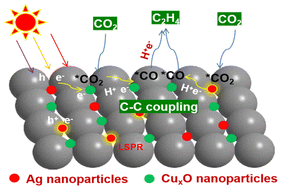
The photocatalytic reduction of carbon dioxide (CO2) into high-value-added chemicals represents a promising strategy to address the energy crisis and global warming. Among various reduction products, the selective generation of ethylene (C2H4) remains particularly challenging. In this study, Ag and CuxO nanoparticle co-modified zeolite TS-1 (Ag–CuxO/TS-1) was successfully synthesized via a combined ion exchange and in situ reduction approach. Under simulated solar light irradiation, the optimized Ag–CuxO/TS-1 catalyst achieves efficient CO2-to-C2H4 conversion, yielding a remarkable C2H4 production rate of 2.02 μmol g−1 h−1 with 100% selectivity toward C2H4. The remarkable activity and selectivity originate from the uniform dispersion of active sites, and the intimate interfacial contact of CuxO and Ag and its optimized CO2 adsorption and broad-spectrum light harvesting capability collectively promote the separation of photogenerated charges and facilitate enrichment of *CO and C–C coupling, as proven by in situ Raman spectroscopy. Moreover, the catalyst demonstrates excellent recyclability, maintaining over 80% of its initial activity after four consecutive reaction cycles. This work highlights the potential of coupling plasmonic metals with zeolite-based confinement environments and defect engineering, providing a feasible strategy for the efficient and selective conversion of CO2 into value-added C2 products.
 Please wait while we load your content...


