


 PLATFORM UPDATE:


A protein-mediated and mechanochemical coupling strategy for the discovery and regulation of solid forms of the active pharmaceutical ingredient, trelagliptin

Abstract
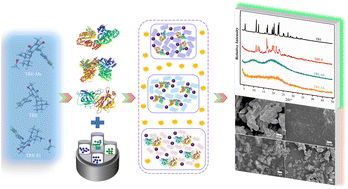
The solid-state form of an active pharmaceutical ingredient dictates its physicochemical behaviour and thus its clinical efficacy and safety. Achieving precise, green and scalable control strategies for solid-state forms remains a central challenge in drug development. This study proposes a protein-mediated mechanochemical coupling strategy that employs human serum albumin (HSA), bovine serum albumin (BSA), or pepsin (PEP) to regulate the solid forms of trelagliptin. Using this approach, novel polymorph and amorphous forms of trelagliptin with excellent properties were discovered. A variety of solid-state analyses confirmed their novelty and distinguished their structural characteristics. Laser-scanning confocal microscopy, molecular docking, and molecular dynamics simulation revealed that trelagliptin strongly binds to all three proteins mainly through hydrophobic contacts and hydrogen bonds. Differences in protein structure give rise to distinct binding modes for TRE. PEP preferentially docks onto the –CN/–C![[double bond, length as m-dash]](https://www.rsc.org/images/entities/char_e001.gif) O-rich crystal face; under shear, it acts as a “molecular key” that collapses the parent lattice and templates nucleation of the new polymorph TRE-F. In original crystals, the –NH2 group is engaged in every hydrogen bond of the lattice. When BSA or HSA intervenes, their surface residues competitively hydrogen-bond to the –NH2 group, disrupting the lattice network of the original crystal and yielding an amorphous phase. This protein-mediated mechanochemical coupling strategy offers a green and readily scalable route for the discovery of drug polymorphs. This work highlights the pivotal role of intermolecular interactions in regulating drug crystal forms and expands the range of environmentally friendly crystal-regulation strategies in crystal engineering.
O-rich crystal face; under shear, it acts as a “molecular key” that collapses the parent lattice and templates nucleation of the new polymorph TRE-F. In original crystals, the –NH2 group is engaged in every hydrogen bond of the lattice. When BSA or HSA intervenes, their surface residues competitively hydrogen-bond to the –NH2 group, disrupting the lattice network of the original crystal and yielding an amorphous phase. This protein-mediated mechanochemical coupling strategy offers a green and readily scalable route for the discovery of drug polymorphs. This work highlights the pivotal role of intermolecular interactions in regulating drug crystal forms and expands the range of environmentally friendly crystal-regulation strategies in crystal engineering.
 Please wait while we load your content...


