


Green and efficient recovery of Mo, Ni, and V from spent residue hydrotreating catalysts with deep eutectic solvents

Abstract
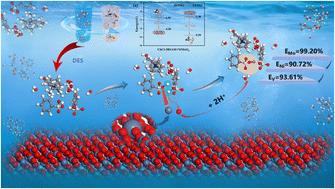
Spent residue hydrotreating catalysts represent a valuable secondary source of critical metals such as molybdenum (Mo), nickel (Ni), and vanadium (V). In this study, a series of deep eutectic solvents (DESs) were systematically evaluated as environmentally benign alternatives for the simultaneous recovery of Mo, Ni, and V from spent catalysts. The results showed that the DES comprising choline chloride (ChCl) and benzenesulfonic acid monohydrate (BSAM) (1 : 3) demonstrated superior leaching performance, achieving leaching efficiencies of 99.20% for Mo, 90.72% for Ni, and 93.61% for V under mild conditions (70 °C, 5 h, and a solid–liquid ratio of 20 g L−1). Mechanistic investigations via FTIR, 1H NMR, Raman, frontier molecular orbital, differential charge density, and Bader charge analyses revealed that the leaching process proceeds through synergistic ion-exchange and strong hydrogen-bonding interactions. Kinetic studies demonstrated that the leaching of Mo and V is diffusion-controlled, whereas Ni dissolution follows surface chemical reaction kinetics. This work highlights the potential of DESs as sustainable and highly efficient leaching agents for recovering valuable metals from spent catalysts, contributing to the advancement of green and circular economy principles.
- This article is part of the themed collection: Green Liquids and Solvents
 Please wait while we load your content...


