


Renewable lignosulfonate salts drive green and efficient acetone, n-butanol, and ethanol (ABE) separation
 *ab
*ab
Abstract
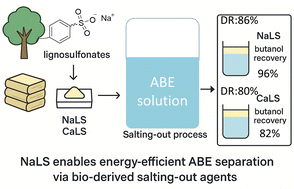
The separation of acetone–butanol–ethanol (ABE) mixtures remains a critical bottleneck in the sustainable production of biofuels due to the high energy demand of conventional distillation for ethanol + water and butanol + water azeotropes. Here, we propose lignosulfonate-based salts (NaLS and CaLS) as renewable, eco-friendly salting-out agents to achieve energy-efficient ABE purification. Systematic experiments revealed that NaLS exhibited superior performance, enabling butanol recovery up to 96% at 40 wt% ABE and 98% at 50 wt% ABE, with dehydration ratios of 86% and 80%, respectively. Multimodal characterization, including elemental analysis, ICP–MS, HSQC NMR, XPS, and contact angle measurements, demonstrated that NaLS possesses enhanced hydrophilicity, stronger ionic dissociation, and more effective solvation disruption than CaLS, thereby underpinning its higher separation efficiency. Beyond improving solvent recovery, this study highlights the valorization of lignin-derived pulping byproducts as functional separation agents, offering a green and circular approach for upgrading bioalcohol purification processes. These findings provide both a sustainable separation pathway and new insight into the molecular design of biobased agents for future biorefinery applications.
 Please wait while we load your content...


