



Engineering FeS/Fe3C nanoparticle-embedded free-standing porous carbon with numerous conductive pathways to enhance electron transfer for oxygen electrocatalysis in rechargeable zinc–air batteries
 *a
Yongfeng
Li
*a
*a
Yongfeng
Li
*a
Abstract
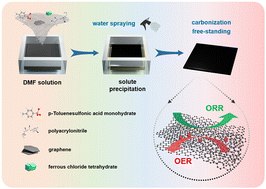
Carbon-based free-standing catalysts can be directly used in rechargeable zinc–air batteries while maintaining a high mass transfer level, making them highly promising as electrodes to catalyze oxygen reduction reaction/evolution reaction (ORR/OER). However, the existing complex preparation processes and limited conductive pathways remain challenges for their further application. Herein, a FeS/Fe3C nanoparticle-embedded and graphene nanosheet-doped carbon catalyst with a free-standing and amorphous porous carbon structure (FeS/Fe3C@CP) is easily synthesized by a simple solute precipitation strategy, in which the well-connected porous carbon and composite graphene nanosheets construct a conductive network extending in all directions. The result of electrochemical impedance spectroscopy (EIS) highlights the lower resistance of FeS/Fe3C@CP in the electron transfer process than that of the electrode synthesized by electrostatic spinning using the same raw material, which confirms that electrons are rapidly transported in this conductive network. The obtained FeS/Fe3C@CP possesses bifunctional catalytic activity and exhibits a half-wave potential (E1/2) of 0.89 V (vs. RHE) for the ORR and a potential of 1.40 V at a current density of 10 mA cm−2 (E10) for the OER. Further, in liquid ZAB applications, the FeS/Fe3C@CP exhibits a power density of 125 mW cm−2, which is better than that of a commercial Pt/C and RuO2 mixture. DFT analysis shows that the ORR adsorption/desorption process occurring on iron atoms in the FeS/Fe3C heterojunction has a smaller energy barrier than that on single FeS or Fe3C nanoparticles. This research lays a practical foundation for the design and synthesis of free-standing carbon catalysts with rich conductive networks.
 Please wait while we load your content...


