


Strategic sodium modulation for low-temperature fabrication of phase-pure Na3V2(PO4)3 cathodes: mechanistic insights and performance optimization in sodium-ion batteries

Abstract
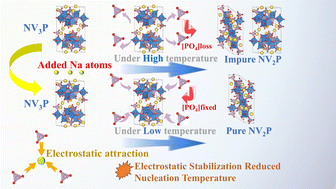
The synthesis of high-purity Na3V2(PO4)3 (NV2P) cathodes is persistently challenged by the formation of Na3V3(PO4)4 (NV3P) impurities and energy-intensive high-temperature processing (>800 °C), which promotes phosphate decomposition and detrimental grain growth. Herein, we propose a green and efficient sodium stoichiometry engineering strategy to overcome these limitations. By employing a 15% sodium excess to suppress impurity formation, we achieved 97.9% phase-pure NV2P at 700 °C. This approach significantly reduces the energy input compared to the conventional process conducted above 800 °C, while also yielding a marked improvement in crystallinity. Excess sodium enhances the thermal stability of PO43−, refines particle size, and improves ion diffusion kinetics. The optimized N-15 cathode delivers a specific capacity of 103 mAh g−1 at 0.1C and retains 93.7% of its initial capacity after 2000 cycles at 10C. While a trace NV3P/NV2P interface enhances high-rate performance, excessive sodium (20%) introduces irreversible impurities leading to capacity decay. This work not only resolves fundamental synthesis barriers but also establishes a scalable, energy-efficient route toward high-performance, low-cost sodium-ion batteries.
 Please wait while we load your content...


