


Plasma-driven electrocatalytic ammonia synthesis: a pulsed NOx replenishment strategy
 †ac
Shuai
Zhang,
cd
Dengke
Xi,
c
Xuekai
Pei,
a
Leslie
Petrik,
e
Cheng
Zhang
*cd
and
Tao
Shao
*acd
†ac
Shuai
Zhang,
cd
Dengke
Xi,
c
Xuekai
Pei,
a
Leslie
Petrik,
e
Cheng
Zhang
*cd
and
Tao
Shao
*acd
Abstract
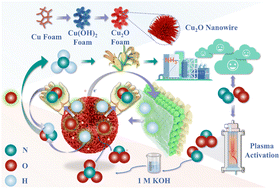
Ammonia (NH3) is emerging as a carbon-free energy carrier and chemical feedstock essential for the clean energy transition. Herein, we present an integrated plasma-electrocatalytic tandem system for sustainable ammonia synthesis directly from air and water. In this process, a rotating gliding arc plasma activates atmospheric nitrogen and oxygen to generate NOx intermediates, which are subsequently electrochemically reduced to ammonia on a Cu2O-based catalyst. By dynamically balancing plasma-derived NOx generation (67 mM within 15 min) and electrocatalytic consumption, a pulsed NOx replenishment strategy is established to maintain stable NOx concentrations (65–70 mM) during prolonged operation. This approach achieves a high ammonia yield rate of 0.648 mmol h−1 cm−2 and a faradaic efficiency of 86.97%, sustaining continuous performance without depletion. The study demonstrates a scalable and energy-efficient route for green ammonia synthesis, offering a promising pathway for decentralized, renewable-powered nitrogen fixation.
 Please wait while we load your content...


