


Microwave-driven catalytic pyrolysis and reforming of methane for hydrogen production
Abstract
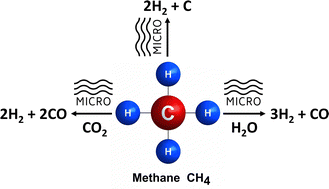
Pyrolysis and dry/steam reforming are considered the predominant technologies for the conversion of methane into hydrogen. In particular, steam methane reforming (SMR) is the most important hydrogen production technology in the industry, but it has some problems such as high energy consumption and carbon emissions. Current research focuses on low-carbon processes (e.g., coupled carbon capture, optimizing catalyst activity, and developing electrothermal reforming) towards sustainable development. Dry methane reforming (DMR) can cause CH4 to react with CO2 to produce syngas, but it is confronted with catalyst carbon deposition and deactivation, high energy consumption, and low H2/CO ratio. Research focuses on the development of anti-carbon deposition catalyst, optimizing reactor design, and coupling with renewable energy to enhance the conversion efficiency and reduce carbon emissions. Methane pyrolysis is an emerging technology that can directly crack CH4 into H2 and solid carbon with zero CO2 emissions. However, high energy consumption and coking of the reactor are the main technical bottlenecks. Research focuses on the catalyst development, reactor innovation, and carbon products for high-value applications. Microwave can provide volumetric heating with a higher energy efficiency than that of conventional heating. Microwave heating can also maintain the stability of the catalyst in methane reforming reactions. Therefore, microwave-driven methane pyrolysis and reforming have received much interest for H2 production owing to low thermal inertia, uniform/volumetric heating, fast heating rate, and high conversion efficiency. This review concludes the progress in methane pyrolysis, SMR, and DMR. Furthermore, the research development and challenges in microwave-driven processes for hydrogen production are highlighted, indicating that a significant gap remains in developing catalysts and reactor systems specifically engineered for the unique mechanisms of microwave heating, rather than merely adapting the conventional ones. It provides the key insight that microwave-driven processes offer a transformative pathway to overcome the persistent challenges of catalyst coking and high energy consumption in traditional methane reforming and pyrolysis. The review further identifies the need for an integrated process design that concurrently optimizes hydrogen production and the valorization of solid carbon to ensure economic viability.
 Please wait while we load your content...


