


 PLATFORM UPDATE:

Engineering the thermostability of lysine hydroxylase for scalable production of (2S)-hydroxy-1,5-pentanediamine from l-lysine
 †a
Kequan
Chen
*a
†a
Kequan
Chen
*a
Abstract
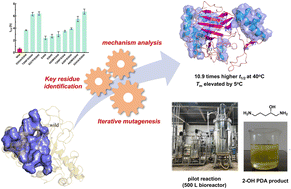
The development of robust enzymes with ideal stability plays a critical role in the construction of practical biotransformation processes. In this work, a native L-lysine hydroxylase from Kineococcus radiotolerans was rationally engineered to improve both thermodynamic and kinetic stability, representing the first case of thermostability engineering of an L-lysine hydroxylase. First, in silico screening based on the calculation of folding free energy (ΔG) was conducted to predict potentially beneficial mutations for stability enhancement in a labor-saving manner. Then, screening of the mutagenesis library revealed key mutations affording improved thermostability without compromising activity. Subsequent combination of the positive mutations enabled further enhancement of enzyme stability with t1/2 (at 40 °C) up to 10.9 times higher and Tm improved by up to 5 °C as well as retained its activity in comparison with the wild-type. Structural analysis revealed that the stability enhancement could be comprehensively attributed to the change in intramolecular interactions, involving interior hydrophobic interactions, VDW forces, and hydrogen bonding, caused by the key mutations at the hotspots. Importantly, the best mutant was applied to a pilot scale dual-enzymatic cascade reaction (300 L) for production of (2S)-hydroxy-1,5-pentanediamine from L-lysine, which achieved an impressive product titer of 70.1 g L−1 with nearly complete conversion, well demonstrating the great practicality of the developed robust mutant. This study provides useful guiding information for the rational design of native enzymes to efficiently develop thermostable mutants for practical industrial manufacturing.
 Please wait while we load your content...


