


 PLATFORM UPDATE:


Latilactobacillus sakei ZFM232 alleviates age-related lipid metabolism disorders and enhances antioxidant defense in Caenorhabditis elegans

Abstract
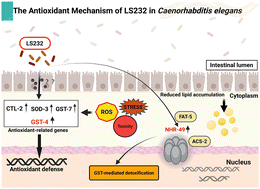
Lactic acid bacteria (LAB) are widely recognized as beneficial microorganisms within the human microbiome; however, the mechanisms underlying their health-promoting effects remain largely elusive. Here, we show that Latilactobacillus sakei ZFM232 (LS232) exhibits tolerance to acidic conditions and moderate salt stress, along with relatively stable antioxidant capacity in vitro. Using Caenorhabditis elegans as an in vivo model, we found that long-term intake of LS232 significantly improved nematode survival under oxidative, osmotic, and heavy-metal stress conditions, with increases of 40%, 36.5%, and 11.9%, respectively, compared to the control group. LS232 feeding also reduced age-related lipid droplet accumulation and triglyceride levels, indicating improved lipid metabolic status during aging. Concurrently, LS232 enhanced glutathione S-transferase 4 (GST-4) activity, promoted superoxide clearance, and improved redox balance in vivo. Moreover, LS232 feeding was associated with increased nhr-49 expression, enhanced nuclear enrichment of NHR-49, and upregulation of lipid metabolism-related genes, including fat-5, fat-6, fat-7, and acs-2. In the nhr-49 mutant background, the beneficial effects of LS232 on lipid accumulation and redox balance were significantly attenuated, further supporting the involvement of an NHR-49-associated regulatory program in mediating these responses. Overall, these results suggest that LS232 has potential applications in alleviating aging-related lipid metabolism disorders and oxidative damage.
 Please wait while we load your content...


